


Who it is for
For people who want to work with tension, with movement that no longer feels comfortable, or with overload after work or sport. You do not need your own diagnosis – it is enough to know what bothers you and what you would like to change.
Athletes book corrective massage too. I adapt the work to the phase of training or load you are in.
What happens
When a particular movement limits you, simply pointing to where it hurts is not enough. I want to know during which activity the problem appears, what you have already tried and whether there is a reason to see a health professional first.
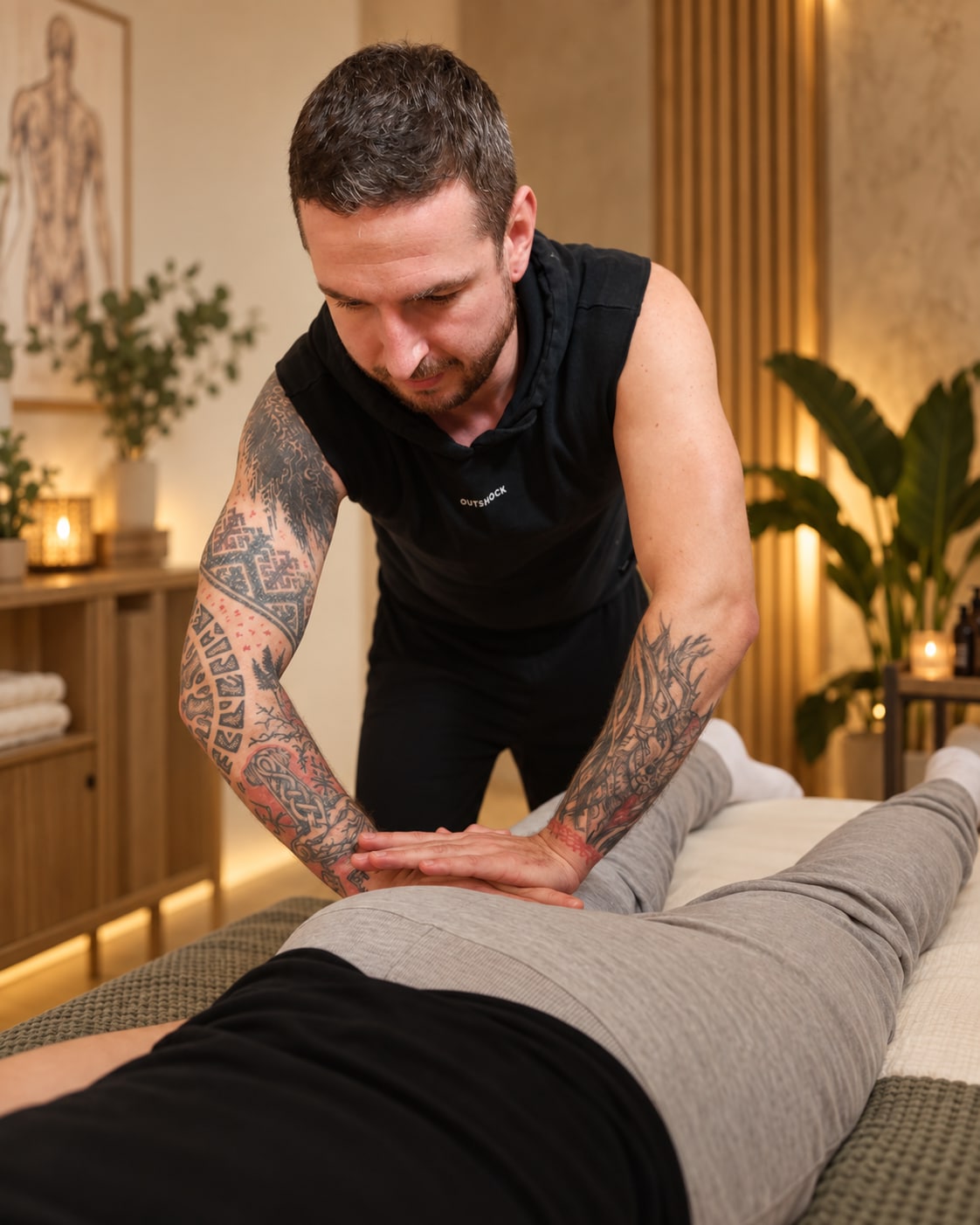
I do not follow one universal routine. As agreed, I work with my hands on soft tissues and joints, and where it makes sense I choose one of my tools – at other times they would only add unnecessary intensity. I keep adjusting the pressure and techniques to how you respond, and we can change or leave them out at any time.
With athletes it matters whether you have training ahead, whether you have just finished a hard effort and what you need to manage in the coming days. Sports work does not mean pressing harder.
Why I sometimes work away from where you feel the tension
Imagine your head does not turn easily when you reverse the car, or your neck pulls when you reach for a high shelf. You feel the tension in one spot, but the movement itself is not the work of a single muscle. When you raise your arm, the shoulder works together with the shoulder blade sliding over the ribcage, and the chest straightens slightly. When you turn your head, the upper back joins in as well as the neck.
That is why, apart from the spot that troubles you, I sometimes work on the surrounding areas too – the chest, shoulder blade or shoulder. Then we check together whether the whole movement has started to feel easier.
This does not mean the cause of your problem is automatically somewhere else, nor that I can make a diagnosis from movement. It is simply another way of looking for more comfortable movement. If working away from the sore spot does not make sense to you, tell me – I will explain why I suggest it, or we will choose another approach.
Not just the back
Besides the back and neck, we can also work on tension around the joints of the arms and legs: the shoulder and shoulder blade, elbow, forearm and wrist, the hip and pelvic area, the knee, the ankle and foot. It is always massage and reconditioning care for ordinary tension and overload, not treatment of an injury or unexplained problems. A fresh injury, swelling, or unexplained or worsening pain should go to a doctor or physiotherapist first.
What to expect
Manual work can bring some people relief or make movement more comfortable. On its own, however, it does not prove that a bone was “put back” or that a single cause of pain was removed. If the problems keep coming back, we look for another practical step too: adjusting your load, suitable movement or a medical examination.
In studies of sports load, massage on average slightly improved perceived delayed muscle soreness and flexibility; a direct improvement in sprinting, strength or endurance has not been shown. Massage also does not work by “flushing out lactic acid” – reviews have not found that it speeds up the removal of lactate from the blood.
Massage does not replace a medical or physiotherapy examination. A conversation and a simple movement give pointers for choosing a safe massage; I do not make a medical diagnosis this way.